
ArticleScore 100
Tampa Bay Buccaneers 2026 Draft Class: Rookie Impact
Jul 3, 2026Ryan McCrystalSharp Football Analysis
Loading Fantasy Redzone…
...answer. It was surprising Tampa didn’t add a tight end until taking Bauer Sharp (seventh round). Sharp can contribute immediately as a blocking tight end...
...mediately and will be a candidate to wear the green dot eventually. Ted Hurst (third round) can’t replace Mike Evans on his own, but he does have the si...
...ear the green dot eventually. Ted Hurst (third round) can’t replace Mike Evans on his own, but he does have the size and speed to take on some of those d...
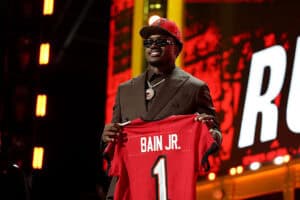
The following is an excerpt from Warren Sharp's 2026 Football Preview . In addition to Warren's deep, detailed write-up on all 32 NFL teams, each chapter features page after page of full-color charts, stats, and heatmaps, as well as draft class analysis from Ryan McCrystal. Click here for a full FREE chapter from the 2026 Football Preview . Every team is excited about their incoming class of rookies, but how will those new players affect each team in 2026? Let's look at the Tampa Bay Buccaneers, breaking down the most likely instant-impact rookies from their class while also providing some insight into why certain early picks may not see the field. Tampa Bay Buccaneers 2026 Draft Class: Which Rookies Will Make an Impact? Perhaps the luckiest team in the draft was the Bucs, who had Rueben Bain Jr. (first round) fall into their lap to address a glaring need for a pass-rusher. Before the draft, the expectation was for the Bucs to reach to fill that need, but instead of reaching, they got one of the steals of Day 1. Bain’s 14.7% pressure rate last season was not spectacular, but Miami’s defensive line was frequently in tight alignments, which suppressed his production. When lined up from the seven-tech position or wider, he generated a stronger 17.8% pressure rate, demonstrating an ability to win with power further inside but also with speed and finesse further on the edge. Bain will likely start immediately opposite Yaya Diaby on the edge. Josiah Trotter (second round) filled Tampa’s second-biggest need on defense, though this selection was more of a risk. Trotter is an aggressive run defender who diagnoses plays quickly and is a reliable tackler. However, he lacks ideal range in coverage, and a series of knee injuries raises doubts as to whether that can dramatically improve. Trotter had an MCL injury in high school, tore his ACL as a freshman in college, and then missed the end of the 2025 season and offseason workouts due to another knee injury. For a player with modest athletic traits to begin with, those injuries are a significant red flag. When healthy, Trotter is expected to start immediately and will be a candidate to wear the green dot eventually. Ted Hurst (third round) can’t replace Mike Evans on his own, but he does have the size and speed to take on some of those downfield targets that often went to Evans. The Bucs will likely use Hurst occasionally as a downfield weapon during his rookie year, but he’s a developmental prospect who likely won’t be ready to compete for a starting job. Based on route-adjusted numbers, Hurst’s catch rate was 5.3% below expected last year, a major concern for a 6-foot-4 receiver playing in the Sun Belt. The Bucs had another Miami player fall into their lap when they selected Keionte Scott (fourth round), who was widely believed to be a Day 2 prospect. Scott is a prototypical nickel corner, a spot that is filled by last year’s third-round pick Jacob Parrish. The Bucs probably didn’t intend on drafting competition for Parrish, but the value was too great to pass up in the fourth round. Like most prospects from Clemson these days, DeMonte Capehart (fifth round) is talented but never lived up to expectations. The former four-star recruit started just six games over six years. Capehart is a good athlete for an interior lineman, but his 5.2% pressure rate as a 23-year-old in the ACC was underwhelming. His testing numbers make it easy to see why Tampa wanted to take a chance on Capehart’s traits, but ex…