ArticleScore 100
Offseason Stealing Signals, Cowboys & Saints
Jun 12, 2026Ben GretchStealing Signals (Ben Gretch)
...in Michael Trigg at the position to go along with Luke Schoonmaker and Brevyn Spann-Ford for their backup TE spots,...
...he position to go along with Luke Schoonmaker and Brevyn Spann-Ford for their backup TE spots, but they weren’t one of the team...
...ege career across three smaller schools. In a lot of ways, this feels like Jalen Coker, as an athletic underappreciated small-school guy, although Flournoy is 27...
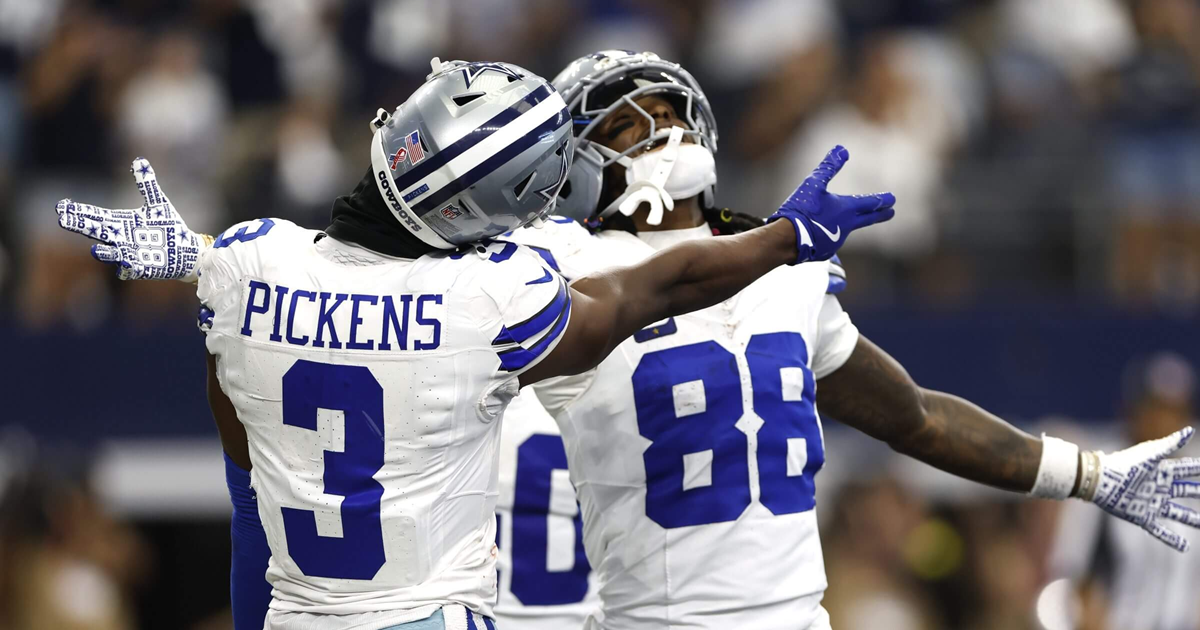
...in now, a potentially healthier CeeDee Lamb , and Ryan Flournoy looking like the best No. 3 WR Dallas has had in some time (they...
..., and he should probably keep those as the Cowboys added a UDFA in Michael Trigg at the position to go along with Luke Schoonmaker </stron...
...ut he factors into the WR targets, for sure). Jake Ferguson’s Field Tippers profile tells the story, but his T...
...an of Establish The Run about how that pace tends to be a Dak Prescott trait that would carry over under a new coaching staff. Dialing i...
...217;s not a difference-maker. The story of Javonte Williams’ 2025 was obviously a bounceback year from his tough final...
...he’ll have another solid rushing year with double-digit TDs. But at a price this high, you need more ceiling than appears to be here in a volume-depen...
...230; The specifics of that gap shouldn’t be overweighted — the sample of three games without Lamb is tiny… The point would be the general...
...t 30 pass TDs. With Pickens locked in now, a potentially healthier CeeDee Lamb , and Ryan Flournoy looking like the best No. 3 W...
...en he’s not a difference-maker. The story of Javonte Williams’ 2025 was obviously a bounceback year from his tough final...
...le, but he factors into the WR targets, for sure). Jake Ferguson’s Field Tippers profile tells the story, but his T...
...ld that opportunity arise, but it was great to see him displace a guy like Jalen Tolbert last year, and cut into KaVontae Turpin’s routes (T...
...high-volume pass offense is an impressive step forward. A good ground game likely helped a bit, but I’d argue the RBs were benefitting from the pass o...
...f is directionally accurate; one of the reasons I was very high on George Pickens throughout last offseason was these pace and concentration trends...
...see him displace a guy like Jalen Tolbert last year, and cut into KaVontae Turpin’s routes (Turpin will likely remain in a rotational gadget...
...trating volume. That can still happen, as we saw with someone like Jaxon Smith-Njigba dominating Seattle’s pass game last year, but it’s a...
I haven’t done the whole introduction of this series yet, so let’s talk a bit about what I’m looking at and why. Two years ago, to start this series, I wrote a one-off piece called, “ The value of team-by-team analyses ,” which broke down why I think “any key predictive metric is table stakes (now),” and there’s value in the subjective. I’ve been discussing the same concept over the past couple weeks, including my thoughts on “ the 60/40 rule .” In the 2024 post on the value of team-by-team analyses, I wrote something I think is as true today as it was then: It’s the case for both of my major series of written content that I believe strongly the edges lie within team analyses. We’ve run into a bit of a problem in the fantasy industry of what I’ve often called “misapplying the aggregate to the specific,” where some of the knowns are that we can’t find miracle stats, and that there will always be high rates of “unexplained variance” in how key football metrics try to explain fantasy scoring, and yet analysts constantly chase the same conceptual framework of trying to build out leaguewide analyses to apply to [players] across rosters as if they are all in the same situations. Don’t get me wrong: I understand the relevance of being situation agnostic. I’ve preached it for years. But we’ve entered the era of fantasy football where player analysis is driving ADP more than ever — the easiest way to identify this is the rise of youth and the fall of aging players year over year in best ball formats, as well as drafters prioritizing the position where talent is a stronger signal (read: WR) and deprioritizing the one where that’s harder to parse (read: RB). There’s been a swing back in the trends I highlighted at the end of that quote, with RBs being prioritized more here in 2026, but the point stands. I still find there to be significant value in understanding that each NFL offense is its own unit, with its own strengths, weaknesses, and scheme. Those things are the unexplained variance — the “40” in the 60/40 rule. We can’t compare things as easily as we’d like because football is a game where it’s inherently challenging to control for all the variables that impact the thing we’re trying to study. That doesn’t mean we can’t do broader analyses; it just gets back to my commentary that we need to understand what the results are telling us, and how to apply them as the league’s macro trends constantly shift. There always seems to be too much confidence in any trend, which doesn’t mean it’s unhelpful to know, but just that the application doesn’t respect the idea of uncertainty. Although, I guess the point I’ve been trying to make for years now is it’s not entirely uncertain — it’s known that the different teams are doing things differently in a way that is going to create too much variance in a model that needs those things normalized. But that doesn’t mean we can’t study that variance. We can try to normalize those things individually . We can make educated guesses. We need to know and respect the trends, but we get to choose how to apply them. This is what all the best fantasy football research is at its core, but people are afraid to admit this, I think. There’s something where it feels arrogant, intellectually, to trust your own processing over the results of some model. As I’ve alluded to in recent pieces, perhaps the best corollary for this right now is AI. I’m definitely trying to use AI as a tool where possible right now, but I’m finding…